Pure Tone Audiometry (PTA) Test: Procedure, Benefits, Results & Cost
Table of Contents
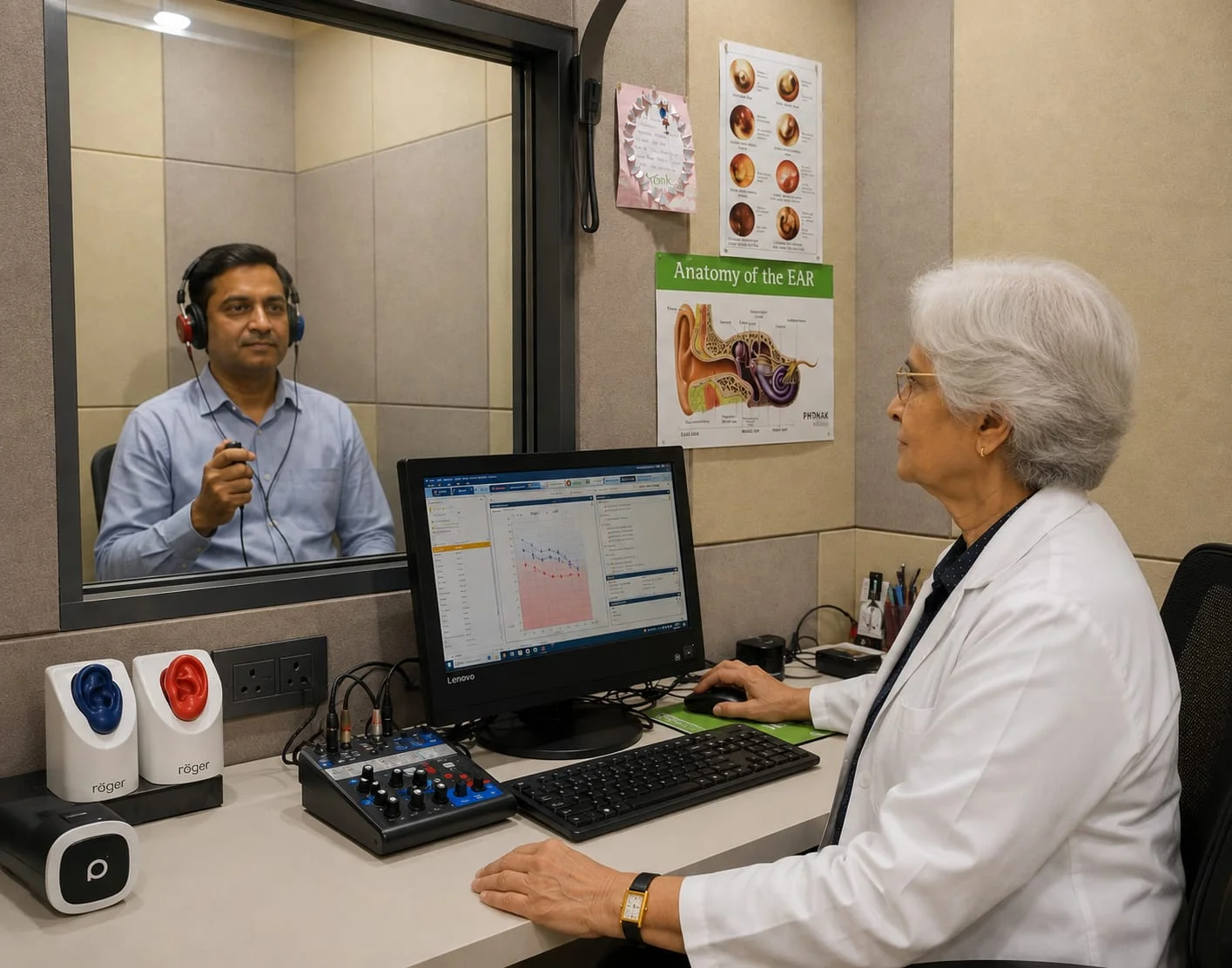
Pure Tone Audiometry (PTA) test is the standard hearing test to determine how well you hear sounds at different pitches and volumes. It helps audiologists to determine hearing loss, the type and severity, and plot on an audiogram. If you have concerns about your hearing, tinnitus or are regularly exposed to loud noise then you should consider having a pure tone audiometry test.
The Importance of Ear Cleaning
Your audiologist will perform an otoscopic exam of your ear before a PTA test to make sure that there is no wax buildup, infection, or fluid in your ear canal. Excessive wax in the ear canal can block the sound from reaching the eardrum, causing abnormally high hearing thresholds. The first is clearing out the ear canal so that your pure audiometry results are representative of your true hearing ability and not a temporary blockage.
What is Pure Tone Audiometry?
Pure Tone Audiometry is a diagnostic hearing test used to measure the faintest sound (hearing threshold) you can hear across a range of different frequencies, from low-pitched to high-pitched tones. The audiologist will present tones using a calibrated audiometer through headphones or a bone conductor. You will signal each time you hear a tone. The results are plotted on an audiogram , which helps determine if there is hearing loss and how severe it is . A normal pure tone audiometry result usually lies between 0 and 25 dB at the frequencies tested. PTA is recommended for anyone who has experienced muffled hearing, difficulty in following conversation, or tinnitus, or is regularly exposed to loud noise.
Who Should Take a Pure Tone Audiometry Test?
The PTA test, also known as pure tone threshold audiometry as it measures your exact hearing thresholds, is recommended for adults with gradual hearing changes, children with delayed speech or attention issues, seniors as part of routine hearing checks, people with tinnitus or dizziness, and anyone with regular exposure to loud noise at work or through the use of headphones. It is also used for hearing aid programming and occupational hearing screening.
The Pure Tone Audiometry Test Procedure
Pure Tone Audiometry Test is usually carried out in a sound treated room/booth to avoid any influence of external sounds. The sound treated room has an ambient noise level of less than 30dB SPL to ensure proper test results. Pure Tone Audiometry test procedure comprises of presenting sounds of different frequencies at different intensity levels through a headphone to the subjects ears. The subject is instructed to respond to the softest sound they can hear. Pure Tone Audiometry Test is usually carried out in a sound treated room/booth to avoid any influence of external sounds. The sound treated room has an ambient noise level of less than 30 dB SPL.
There are two modes of presentation – Air conduction through a headphone fitted on the ears and Bone conduction through a bone vibrator placed on the mastoid bone.
The tester varies the intensity levels and uses a bracketing method to identify the hearing threshold at each frequency based on the response of the subject to the presented tone. Both right and left ears are tested individually using a similar procedure. In case required, masking would be done using noise in the opposite ear.
Once all frequencies have been tested, the threshold levels are marked for the Right and left ears individually in Red and Blue respectively, on an audiogram report.
Understanding Pure Tone Audiometry Test Results
Regardless of how much you paid for pure tone audiometry, the most important thing is to understand your results when your test is over. Your results will be plotted on an audiogram, which is a graph showing hearing thresholds in decibels (dB) at frequencies measured in Hertz (Hz). Thresholds are generally classified as: normal hearing (0–25 dB), mild loss (26–40 dB), moderate loss (41–55 dB), moderately severe (56–70 dB), severe (71–90 dB) and profound loss (90+ dB). Your audiologist will review your audiogram with you and explain what the pattern of results means for your hearing in everyday situations.
Suggested visual: simple audiogram diagram/table with frequency (Hz) on x-axis, hearing level (dB) on y-axis, shaded bands for severity categories.
Benefits of Pure Tone Audiometry
PTA testing can identify hearing loss as early as possible before it has a major impact on communication, provide a baseline for monitoring changes in hearing over time, and provide the precise data needed to fit and program hearing aids accurately. It is also used for occupational hearing screening in noise-exposed workplaces and helps guide treatment planning for tinnitus and other auditory disorders. Finding pure tone audiometry near me is easy with clinics like Quality Hearing Care having convenient scheduling available throughout Mumbai.
Suggested visual: simple audiogram diagram/table with frequency (Hz) on x-axis, hearing level (dB) on y-axis, shaded bands for severity categories.
Pure Tone Audiometry Test Price
The cost of PTA testing varies among clinics and geographic locations. The price may also vary depending on whether it is a stand-alone test or part of a complete hearing evaluation, which may include tympanometry or speech audiometry, and a consultation fee that may be bundled with the assessment. For a full breakdown of what’s involved, see our Pure Tone Audiometry Test Procedure section above. Reach out to our clinic directly at Quality Hearing Care for current pricing we’re happy to go over what’s included before you book.
Audiometry Tests Near Me
Looking for Pure Tone Audiometry Test in Mumbai nearby you? Experience the best hearing test at Quality Hearing Care clinics in Vile Parle and Andheri West, conducted by seasoned audiologists with calibrated diagnostic equipment for precise results. Schedule your test online or call ahead.
Why Choose Quality Hearing Care for a PTA Test?
- All tests performed by qualified and trained audiologists
- Calibrated diagnostic equipment for accurate and reliable results
- Clear and simple explanation of your hearing test
- No pressure to purchase hearing aids and tailored care
- Easy access to clinics in the western suburbs of Mumbai
Conclusion
A Pure Tone Audiometry test is an important, quick and painless step to understand your hearing health. Early assessment means better treatment whether you’re experiencing the early signs of hearing loss or simply want a baseline check.
FAQs
Pure Tone Audiometry (PTA) is a non-invasive hearing test used to measure the softest sounds a person can hear at different frequencies. The results are recorded on an audiogram to evaluate hearing levels in each ear.
During a PTA test, different tones are presented through headphones at varying intensity levels, and the patient responds to the softest sound they can hear. Air conduction and bone conduction testing may be performed to assess hearing in each ear.
Ear cleaning may be necessary if earwax is blocking the ear canal. An otoscopy is performed before the test to check the ear canal and eardrum because blockage from earwax can affect the accuracy of PTA results.
A Pure Tone Audiometry test can generally be completed in under 30 minutes. The test is usually conducted in a sound-treated room or booth to minimise the effect of external noise on the results.
The cost of a Pure Tone Audiometry test generally ranges from ₹500 to ₹1,500, depending on the location and test protocol. At Quality Hearing Care, PTA testing is available at its Vile Parle East locations in Mumbai."
Related Post
-
 How Untreated Hearing Loss Can Affect Your Overall Health: It’s About More Than Just Your Ears
 -
 Ear Infection and Hearing Loss: What’s the Connection?
 -
 The Importance of Regular Hearing Check-Ups: Why Every Hearing Test Matters
 -
 Can Hearing Loss Be Reversed? What Patients Need to Know
 -
 Why Can I Hear Sounds But Not Understand Words? Understanding Hidden Hearing Loss
 -
 What's the Difference Between an Audiologist and an ENT?
 -
 6 Diseases That Cause Hearing Loss: Understanding the Connection
 -
 Why a Hearing Test Alone Is Not Enough Before Choosing Hearing Aids
 -
 How Do I Know If My Hearing Aids Are Adjusted Correctly?
 -
 Signia Hearing Aid Price in India (2026)
 -
 Understanding Communication Issues in Elderly Patients: The Distinction Between Hearing and Listening
 -
 Hearing Loss: Types, Symptoms, Causes & Treatment
 -
 Age-Related Hearing Loss (Presbycusis)
 -
 How to Safely and Properly Clean Your Ears- Methods & What to Avoid
 -
 Hearing Aids- Benefits, Different Styles/Types and How They Work
